Market News
Pending Home Sales Drop 5.4% in June: What Buyers Should Know
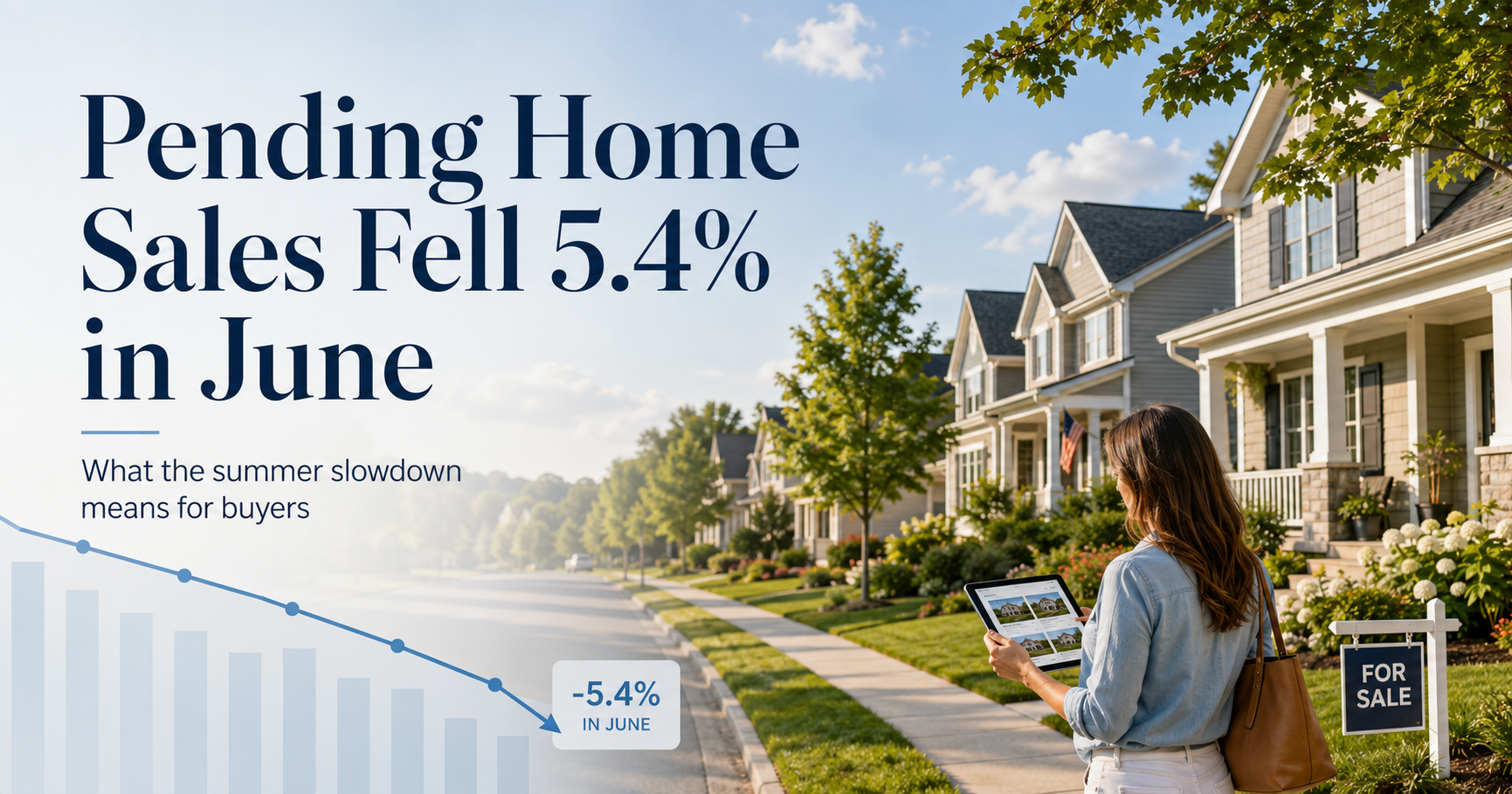
The latest data from Realtor.com Research, published July 16, 2026, shows that pending home sales dropped 5.4% from May to June. On an annual basis, the decline was much smaller, just 0.3% below where things stood a year ago. In other words: the market pulled back, but it has not fallen off a cliff. For buyers who are in the middle of their search or just starting out, the picture is more nuanced than a single headline suggests.
What "Pending Sales" Actually Means for Your Timeline
A pending home sale is a signed contract between a buyer and seller. It is the moment a home goes "under contract" but before the deal officially closes. Because pending sales typically lead closings by one to two months, they act as an early signal of where the market is headed in the near term.
A drop in pending sales means fewer buyers locked in deals in June. That is worth noting, but it does not necessarily mean the market is in trouble.
Why Did Sales Slow Down in June?
A few forces were at work at the same time:
- Mortgage rates stayed elevated. According to Realtor.com, rates hovered around 6.5% throughout June. That level is still high enough to make monthly payments a stretch for many buyers, even if rates are slightly below where they were a year ago.
- It is a seasonal shift. The spring buying season naturally winds down as summer arrives. Families lock in moves before the school year, and then activity tends to quiet. This June pullback fits that familiar pattern.
- Affordability is improving, just slowly. Realtor.com notes that the typical monthly payment is running about 1.9% below last year's level. That is real progress for buyers, even if it does not feel dramatic.
How Did Different Regions Perform?
All four U.S. regions saw contract signings fall in June, but the magnitude varied quite a bit:
- Midwest: biggest monthly drop at 8.9%, though still up 0.3% year over year
- West: down 4.7% month over month, and down 1.1% annually
- South: down 4.1% month over month, and down 0.9% annually
- Northeast: the smallest monthly dip at 3.0%, and the only region showing meaningful annual growth at 2.2%
At the metro level, some markets bucked the trend entirely. Virginia Beach (+15.4%), Sacramento (+15.2%), and Kansas City (+14.4%) all posted strong year-over-year gains in pending sales. Austin, Texas was also notable with an 11.1% annual increase, a shift that Realtor.com attributes to growing inventory and softening prices there.
If you are shopping in one of these markets, conditions may feel quite different from the national trend.
What Does the Rest of 2026 Look Like?
Realtor.com's Midyear Forecast Update, referenced in the same report, revised several key projections. The mortgage rate outlook for the year held at 6.3%, while forecasts for existing home sales, prices, and inventory growth were all nudged lower. The expectation is still for year-over-year gains across those measures, just more modest ones than originally anticipated.
There is also a potentially meaningful development on the inflation front. June inflation data showed headline inflation falling to 3.5% and core inflation easing to 2.6%. Softer inflation readings can open the door to future rate cuts by the Federal Reserve, which could eventually translate into lower mortgage rates. That is not guaranteed, but it is a signal worth watching.
Inventory continues to grow, which gradually shifts negotiating power toward buyers. The market is not a buyer's paradise yet, but it is more balanced than it was two or three years ago.
What This Means If You Are Getting Ready to Buy
A quieter summer market can actually work in your favor as a buyer. Less competition, more time to make thoughtful decisions, and sellers who may be more open to negotiation. Here is how to think about your next steps:
- Know your numbers before you shop. With rates around 6.5%, your purchasing power is sensitive to even small rate changes. Running the actual math on monthly payments, including taxes, insurance, and any HOA costs, is essential before you fall in love with a listing.
- Watch your local market, not just the national number. National headlines can be misleading. Your city or metro may be seeing more or less activity than the national average.
- Stay alert to rate changes. If inflation continues to cool and the Fed responds, mortgage rates could shift. Having your pre-approval ready means you can move quickly if conditions improve.
- Explore down payment assistance. Many buyers do not realize how much help is available. Programs vary widely by state and county, and they can meaningfully change what is affordable for you.
Ready to see how today's rates and local programs affect your specific situation? Head over to The Homebuyer Toolkit and start for free. You can model your real monthly payment, discover down payment assistance in your state, and build a timeline that fits your goals.
The Bottom Line
A 5.4% monthly drop in pending sales sounds alarming, but context matters. It reflects a normal seasonal slowdown, elevated but slightly improving mortgage rates, and a market that is still gradually tilting toward buyers. The fundamentals heading into summer 2026 are steadier than the headline suggests. Stay informed, do your math, and use the slower season to get prepared.
Stop reading about buying a home. Start doing it.
- Run your real numbers against today's rates
- Find down payment assistance for your state
- Build a personalized timeline, with a personal AI guide
Frequently asked questions
Why did pending home sales fall in June 2026?
According to Realtor.com Research, pending home sales fell 5.4% month over month in June due to a combination of factors: the natural end of the spring buying season, mortgage rates hovering around 6.5%, and generally cautious buyer sentiment. The annual decline was much smaller at just 0.3%.
What are pending home sales and why do they matter to buyers?
Pending home sales represent signed contracts between buyers and sellers before a deal officially closes. They typically lead actual closings by one to two months, making them a useful early signal of where the housing market is headed in the near term.
Which housing markets saw pending sales growth in June 2026?
Despite the national dip, several metros posted strong year-over-year gains. Virginia Beach led with +15.4%, followed by Sacramento (+15.2%), Kansas City (+14.4%), and Austin, Texas (+11.1%), according to Realtor.com metro-level data.
Will mortgage rates go down in the second half of 2026?
Realtor.com's Midyear Forecast Update projects mortgage rates averaging around 6.3% for the year. June inflation data showed some softening, which could eventually support lower rates, but no specific timing is certain. It is worth monitoring and having a pre-approval ready so you can act if rates improve.
Is summer 2026 a good time to buy a home?
A slower summer market can benefit buyers through less competition and potentially more negotiating room. Inventory is still growing, gradually shifting conditions in buyers' favor. Affordability is also modestly better than a year ago, with typical monthly payments running about 1.9% lower year over year, per Realtor.com.