Market News
Existing Home Sales Dip in June, Prices Hit a Record $440,600
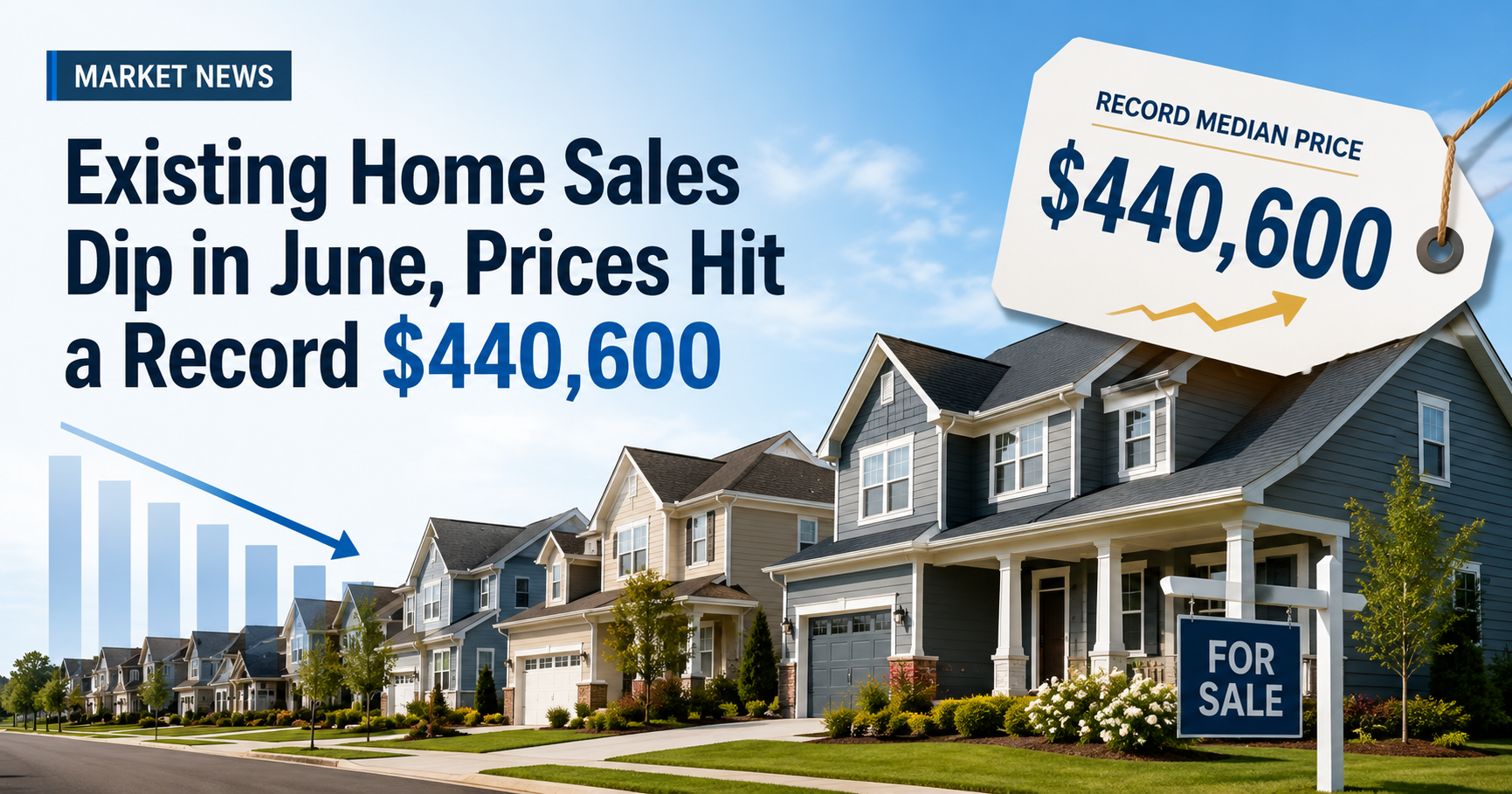
The latest snapshot of the U.S. housing market is in, and it tells a story that many aspiring buyers already feel in their bones: buying a home is still expensive, competition is still real, and rate sensitivity is shaping the whole market. According to the National Association of Realtors (NAR), existing home sales fell 2.4% in June 2026 to a seasonally adjusted annual rate of 4.09 million units. At the same time, the median sales price climbed to a record $440,600. HousingWire reported the data on July 9, 2026.
If you are on the path to homeownership, here is how to read what just happened and what it means for your next move.
Sales Pulled Back, But the Year-Over-Year Picture Is Better
A 2.4% month-over-month drop sounds discouraging, but context matters. Compared with June 2025, existing home sales were actually up 2.8%. That means the broader trend is still pointing in a positive direction, even if each month brings its own wobble.
NAR Chief Economist Lawrence Yun described the pattern as "back-and-forth in monthly home sales activity, driven by mild fluctuations in mortgage rates." In plain terms: when rates tick up even a little, some buyers step back. When rates ease, they re-engage. That sensitivity is a signal about just how stretched affordability already is for many households.
Prices Keep Climbing, Now at a Record High
The median existing home sales price hit $440,600 in June, up 1.8% from $432,700 a year earlier. June was also the 36th consecutive month of year-over-year price gains. That is a three-year streak without a single month of annual price decline.
What does this mean for buyers? A few things:
- Waiting has a cost. Three straight years of gains show that prices have not corrected in any meaningful way. Buyers who hoped for a price pullback have largely not seen one.
- 1.8% annual growth is slower than recent years. While prices are still rising, the pace has moderated. That is a more sustainable environment than the double-digit swings seen earlier this decade.
- Your purchasing power is still being squeezed from two sides: elevated prices AND rates that remain above 6.5% for a 30-year fixed loan (currently around 6.83%, per HousingWire's reported rate data).
Inventory Edged Down, But It Is Still Better Than a Year Ago
Housing inventory came in at 1.56 million units at the end of June, a slight 0.6% dip from May. However, that figure is still 1.3% higher than June 2025, representing a 4.6-month supply of homes.
A 4.6-month supply sits just below the 5 to 6 months that economists typically consider a balanced market. That means:
- Sellers still hold some advantage in most markets, but it is not as extreme as the 1 to 2 month supply seen during the pandemic frenzy.
- More homes are available than a year ago, which gives buyers at least marginally more options and slightly more negotiating room in some areas.
- Regional variation matters a lot. Sales rose month-over-month only in the Northeast, while the Midwest, South, and West saw declines. Your local market conditions could look quite different from the national headline.
Job Growth Is a Silver Lining Worth Noting
Yun pointed out that more than half a million jobs have been added in the U.S. since the start of 2026. That kind of employment growth matters for housing in a couple of ways. It keeps household incomes moving upward, which supports demand even when prices and rates are high. It also means lenders are seeing a pool of borrowers with relatively stable income histories, which can help with qualifying.
Rising wages do not erase the affordability challenge, but they do help explain why the market has not stalled out completely despite elevated costs.
What First-Time Buyers Should Take Away
If you are in the early or middle stages of your home buying journey, here is a practical way to think about this data:
- Do not let record prices paralyze you. Prices being at a record does not automatically mean now is the wrong time to buy. Your decision should center on your own finances, your local market, and how long you plan to stay in the home.
- Rate sensitivity is real. The market is showing you that even small rate moves shift buyer activity. If rates dip, competition can pick back up quickly. Staying pre-approved and financially ready keeps you positioned to act.
- Inventory improvements are modest but real. You have more choices than buyers did a year ago. Use that to your advantage by being thorough in your search.
- Down payment assistance could change your equation. With prices at record levels, many buyers are surprised to find DPA programs still available in their state.
Ready to see how today's prices and rates affect your actual monthly payment? Use The Homebuyer Toolkit to run your real numbers, explore down payment assistance for your state, and build a step-by-step buying timeline, all for free.
The Bottom Line
June's data reinforces a theme that has defined the housing market for the past few years: prices remain stubborn, inventory is improving slowly, and mortgage rates continue to be the primary dial controlling how many buyers show up each month. As a buyer, the best thing you can do is focus on what you can control, your credit, your savings, your local knowledge, and your preparation, rather than waiting for a market shift that may not arrive on your timeline.
Stop reading about buying a home. Start doing it.
- Run your real numbers against today's rates
- Find down payment assistance for your state
- Build a personalized timeline, with a personal AI guide
Frequently asked questions
Why did existing home sales fall in June 2026?
According to NAR, higher mortgage rates reduced buyer demand, causing existing home sales to drop 2.4% month-over-month to a seasonally adjusted annual rate of 4.09 million units. However, sales were still up 2.8% compared with June 2025.
What is the median home price in the U.S. right now?
The median existing home sales price reached a record $440,600 in June 2026, up 1.8% from $432,700 a year earlier, according to NAR data reported by HousingWire on July 9, 2026.
How much housing inventory is available for buyers?
At the end of June 2026, there were 1.56 million existing homes for sale, representing a 4.6-month supply. That is slightly below the 5 to 6 months considered a balanced market, but 1.3% more inventory than was available a year earlier.
Is now a good time to buy a home given record prices?
The right time to buy depends on your personal finances, local market, and how long you plan to stay in the home. Record national prices do not automatically mean buying is wrong for you. Consulting a licensed financial advisor or HUD-approved housing counselor can help you assess your specific situation.
How do mortgage rates affect the home buying market?
The June 2026 data illustrates that buyers are highly sensitive to even small mortgage rate changes. When rates rise, fewer buyers can afford to purchase, slowing sales. When rates dip, demand tends to pick back up quickly, which is why staying pre-approved keeps you ready to act.